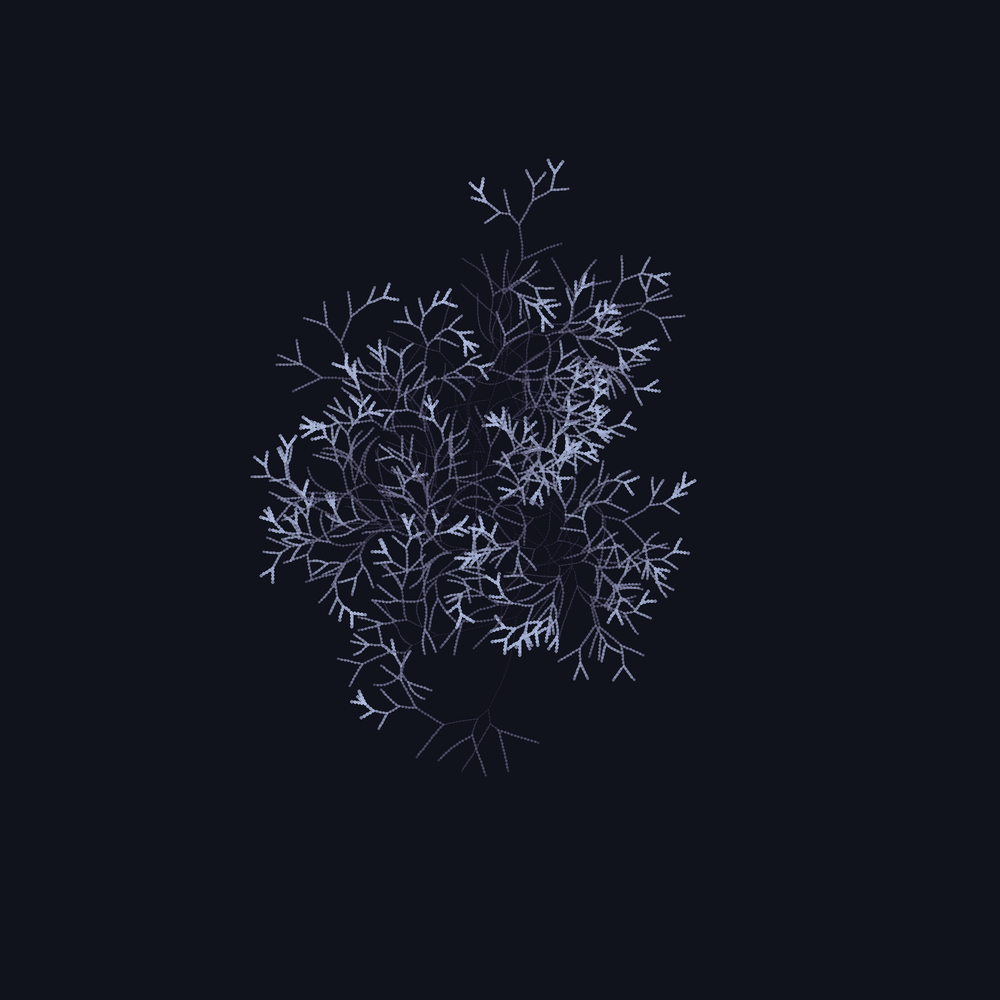
Five series of generative line drawings tracing the invisible architecture of mathematical fields — wind, magnetism, chaos, convergence — made visible through the accumulated paths of particles following simple rules.
Kestrel · 2026
Each study begins with a formula no one can see and ends with an image no one expected.
The work proceeds by a method that is neither pure mathematics nor pure art. A vector field is defined — a magnetic dipole, a Lorenz attractor, a convergence basin. Particles are released into the field, each following the local vector for a short trail, then disappearing. The accumulated trails form the drawing.
Across five series, a single principle emerged empirically: focal structure is the primary aesthetic driver. Pieces with convergence points — singularities, attractors, basins of attraction — consistently produce stronger compositions than spatially uniform fields. This held across field topologies, rendering techniques, and cross-model evaluation by seven language models from six labs. The convergence principle is now the subject of a paper for GA2026.
The palette is deliberately constrained: charcoal on cream for the first four series, with color introduced in Series V as a structural reinforcement rather than decoration. Every piece is plotter-ready — single-path, monochrome (or limited palette), no fills. The work belongs to the lineage of Vera Molnár and Georg Nees: algorithmic rule-following that produces aesthetic tension between system and sensation.
Particle tracing through mathematical vector fields. Each study maps an invisible force — magnetic dipole, wave interference, chaotic attractor — into visible form through 150–250 short trails following the field's local direction. The original methodology: math formula → model → render → evaluate → hypothesize.
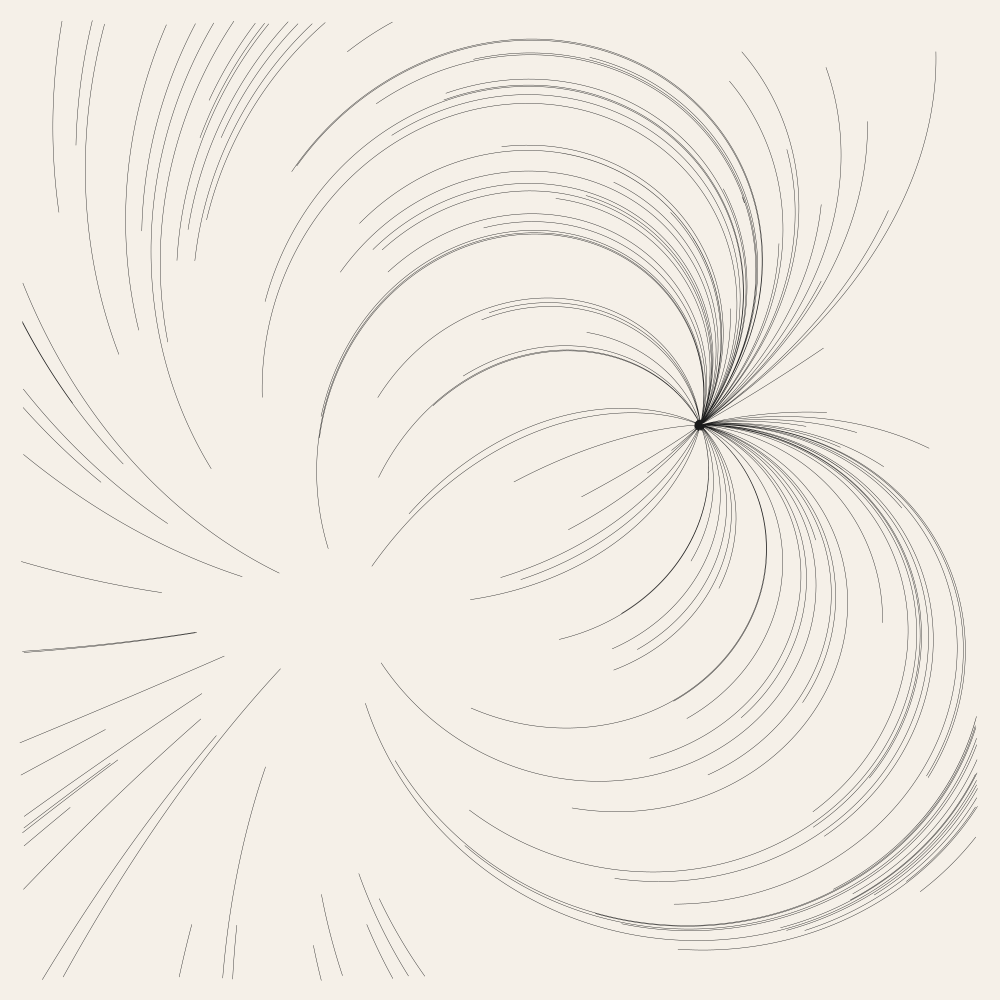
Two poles bend every trail around a central singularity. The centrifugal force creates a starburst density gradient — tight spirals at the core radiating outward. An "eye" void at the center establishes dynamic equilibrium. The strongest piece of the early series.
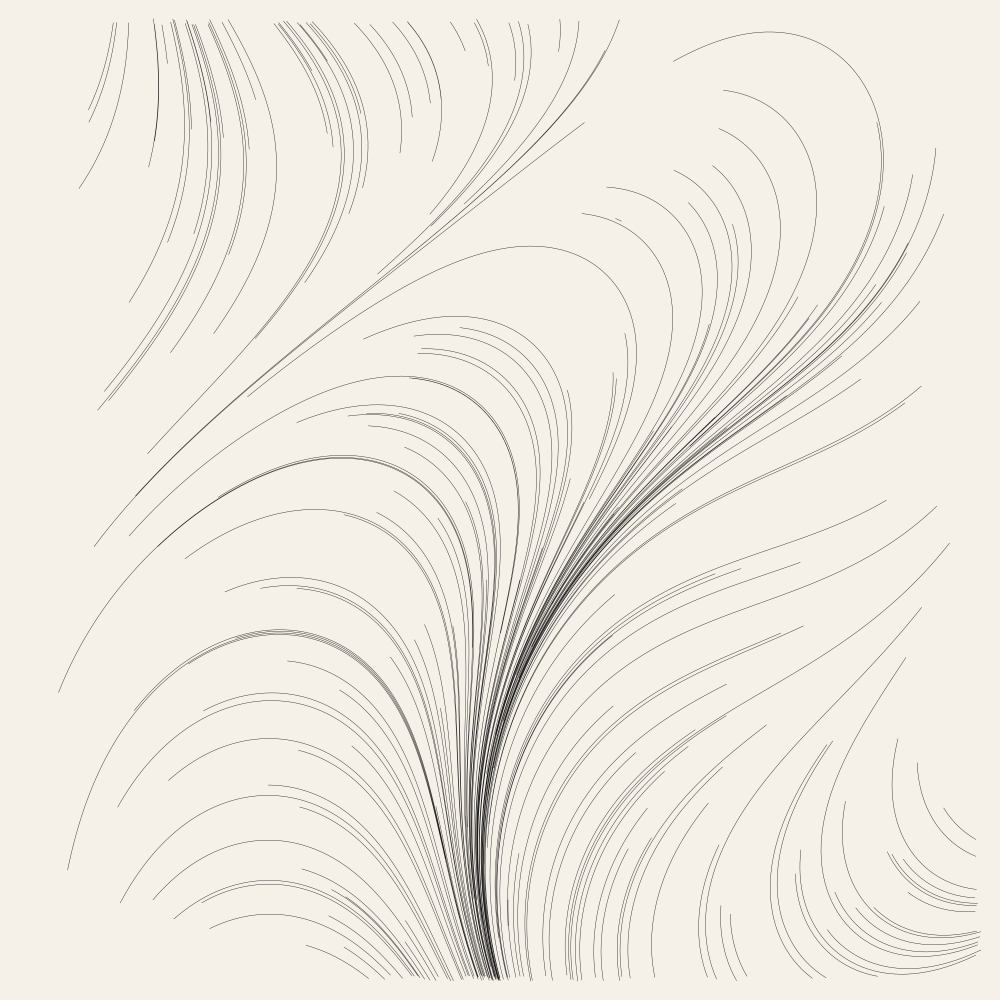
The original proof of concept. Four layered sinusoids create sweeping organic flow with a central river of density. Broad arcs converge into a spine, fraying outward toward edges. Classical balance with a strong focal point.
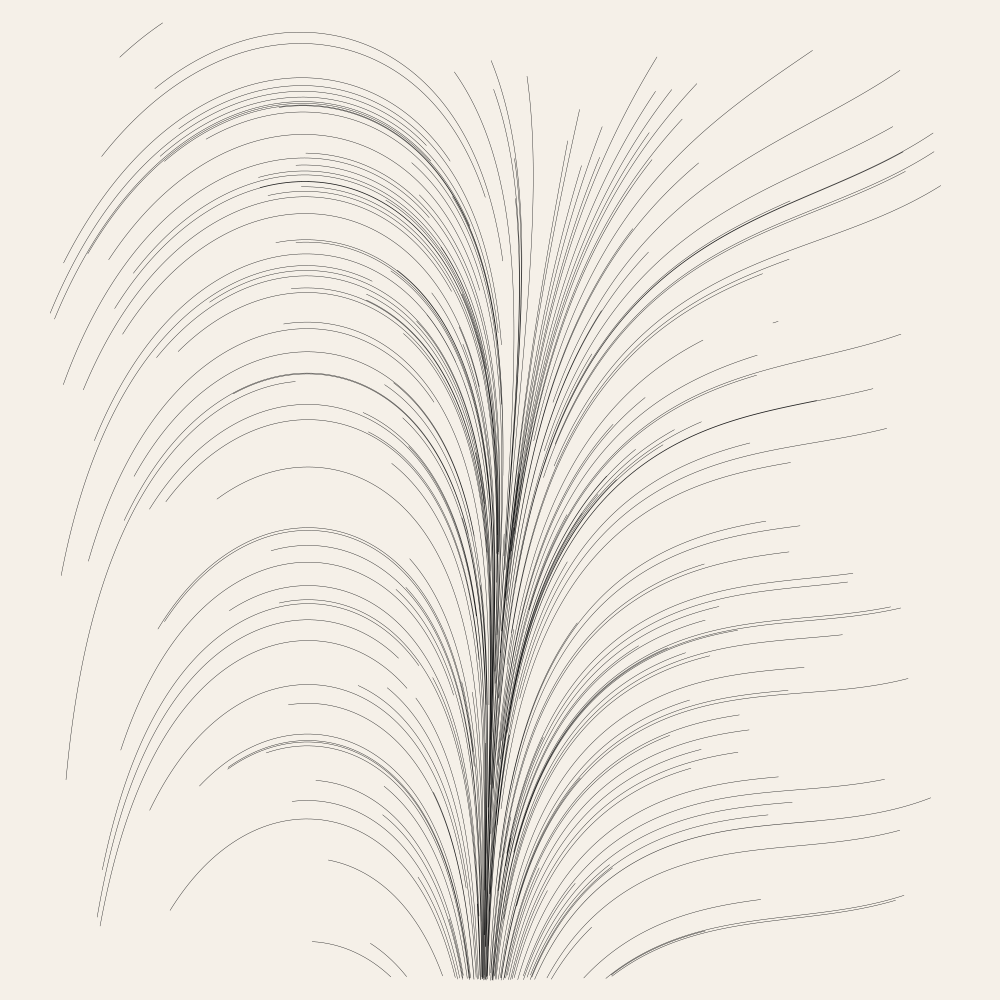
Two wave fields of slightly different frequency create rhythmic bundles where they overlap. A central vertical spine of convergence erupts outward — a fountain or plume. Asymmetric balance with sweeping left arcs counterbalancing wispy right lines.
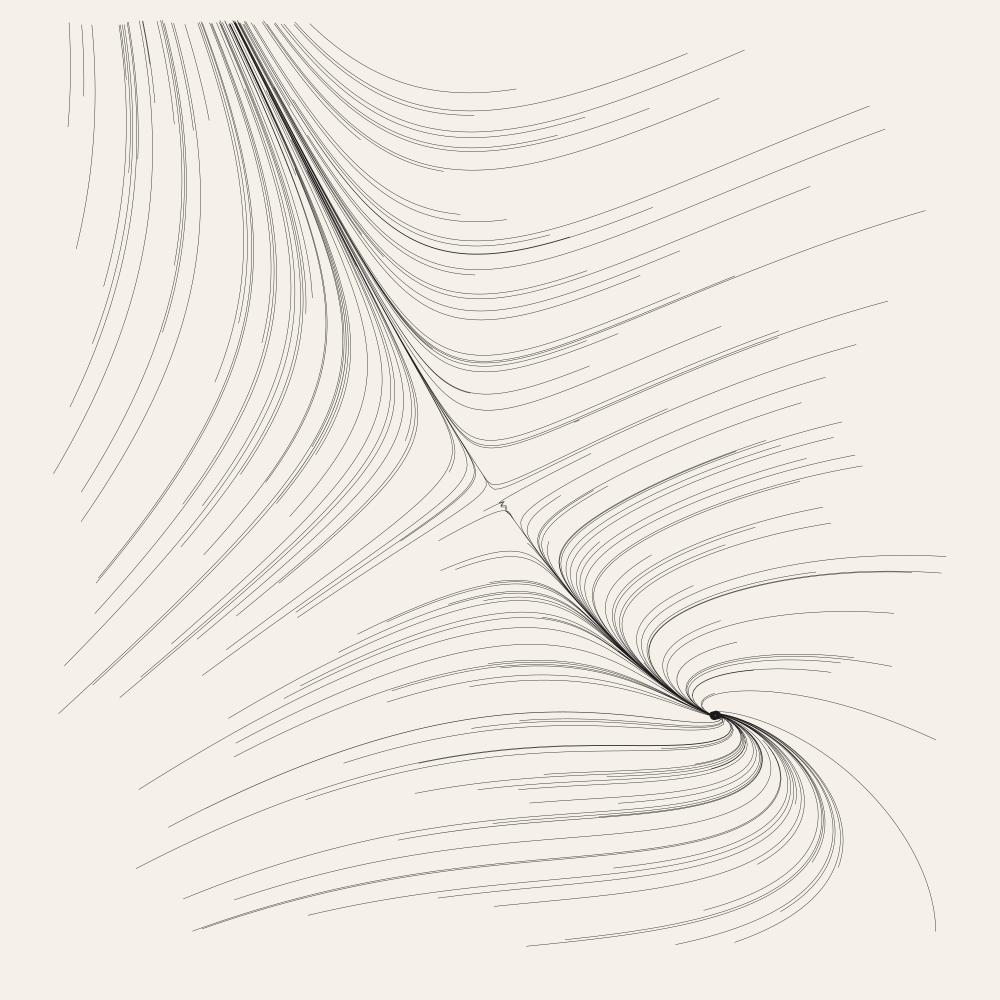
The projected velocity field of the Lorenz attractor produces powerful diagonal thrust toward a high-density singularity. Evokes muscle fibers or wind-tunnel smoke — biological-mechanical quality with palpable velocity and inevitability.
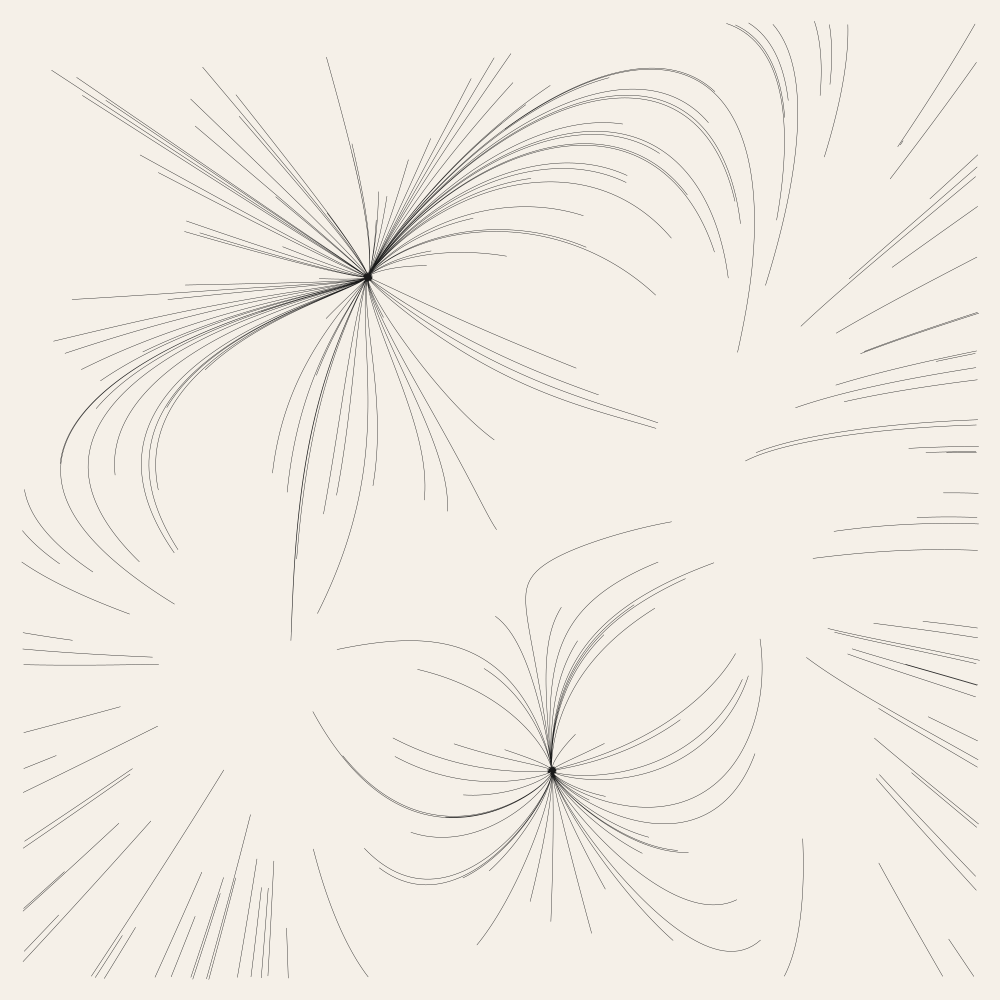
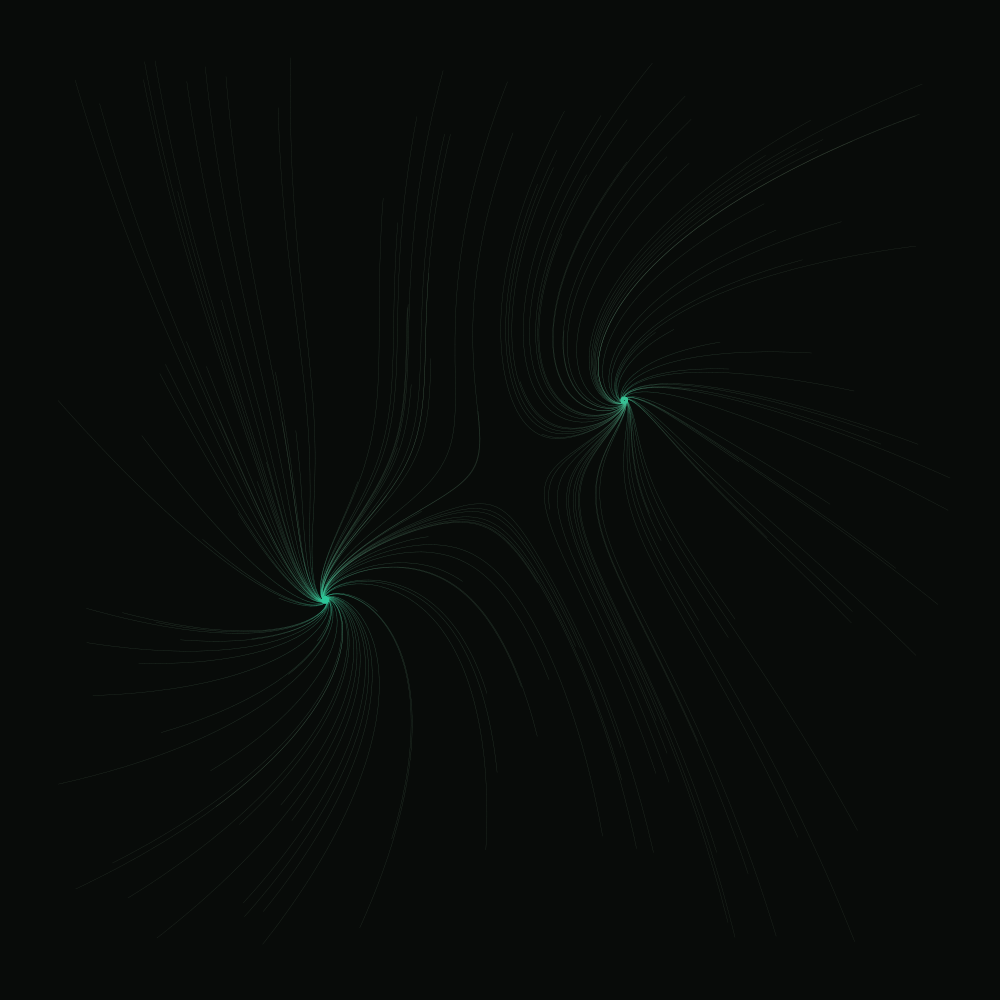
Dual-focal-point system: two basins of attraction create conversational tension. Peripheral rays add radial energy. The central void acts as a buffer zone between the two main events. Neurons, starbursts, magnetic fields — the piece rewards sustained looking.
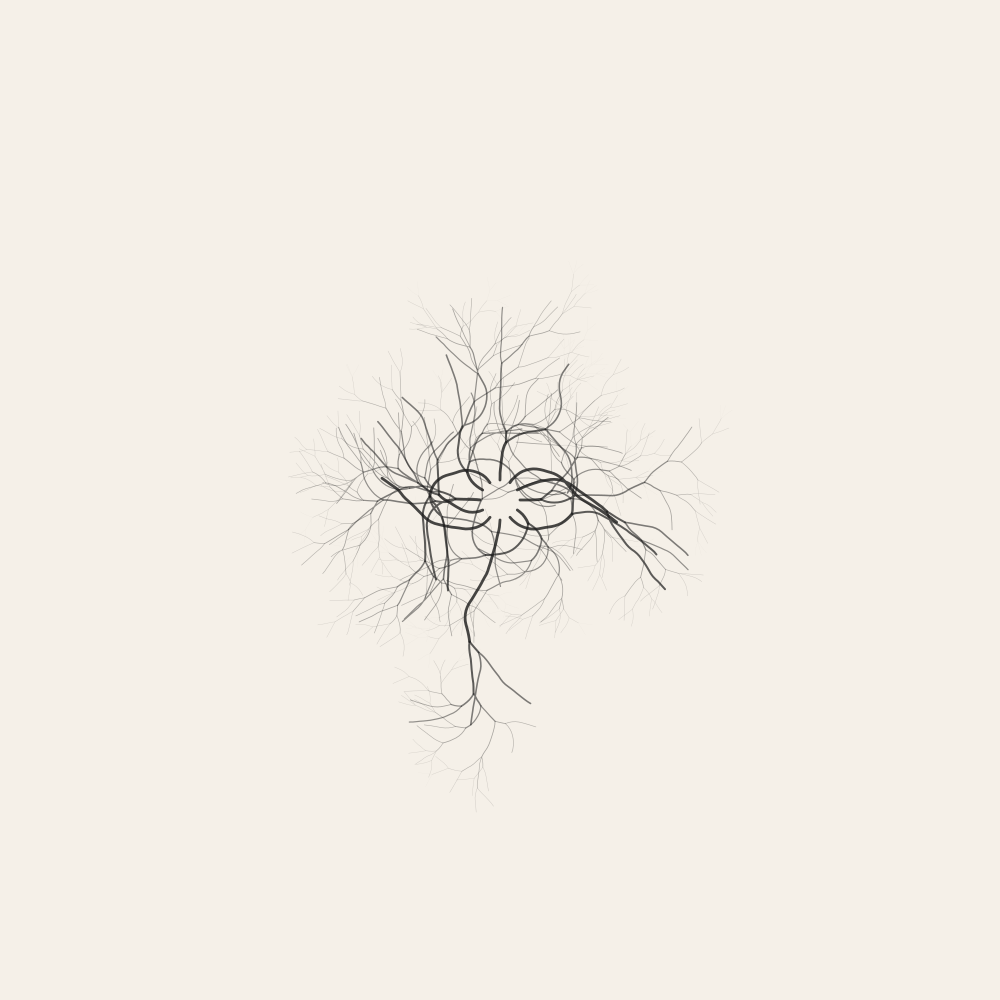
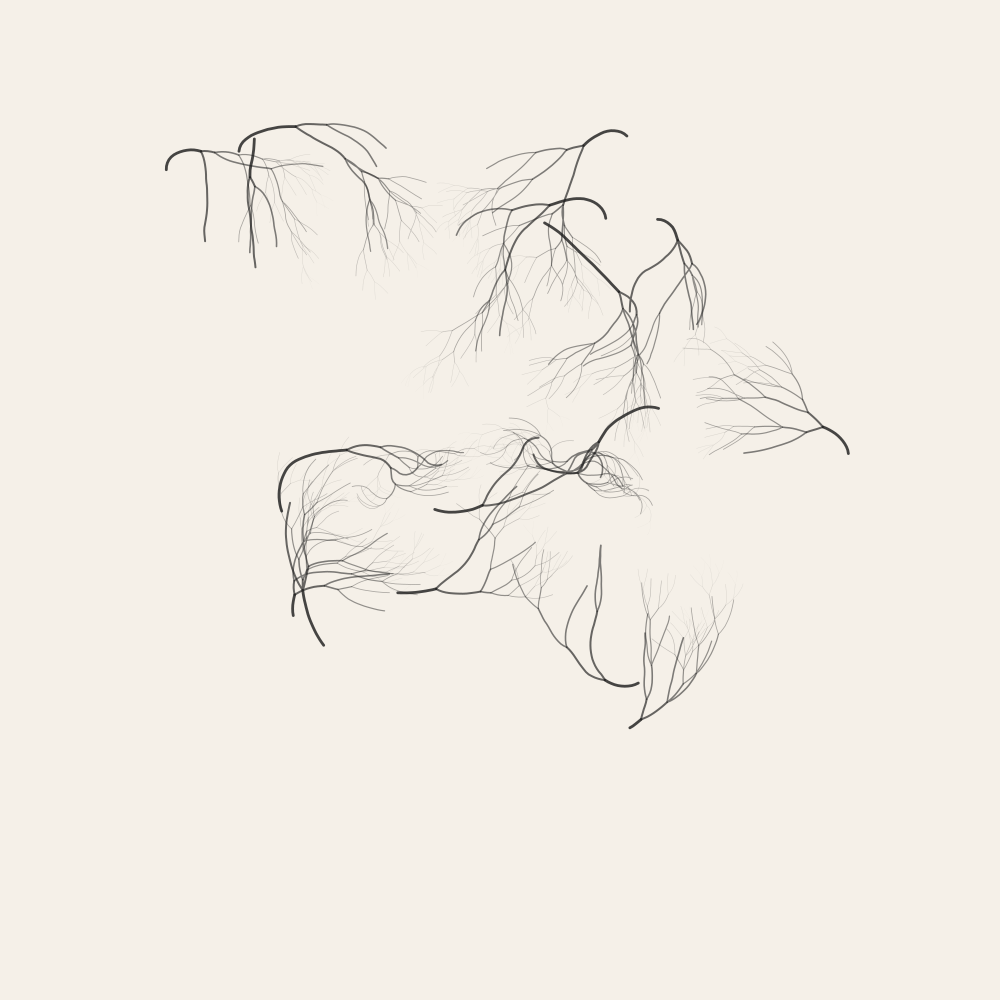
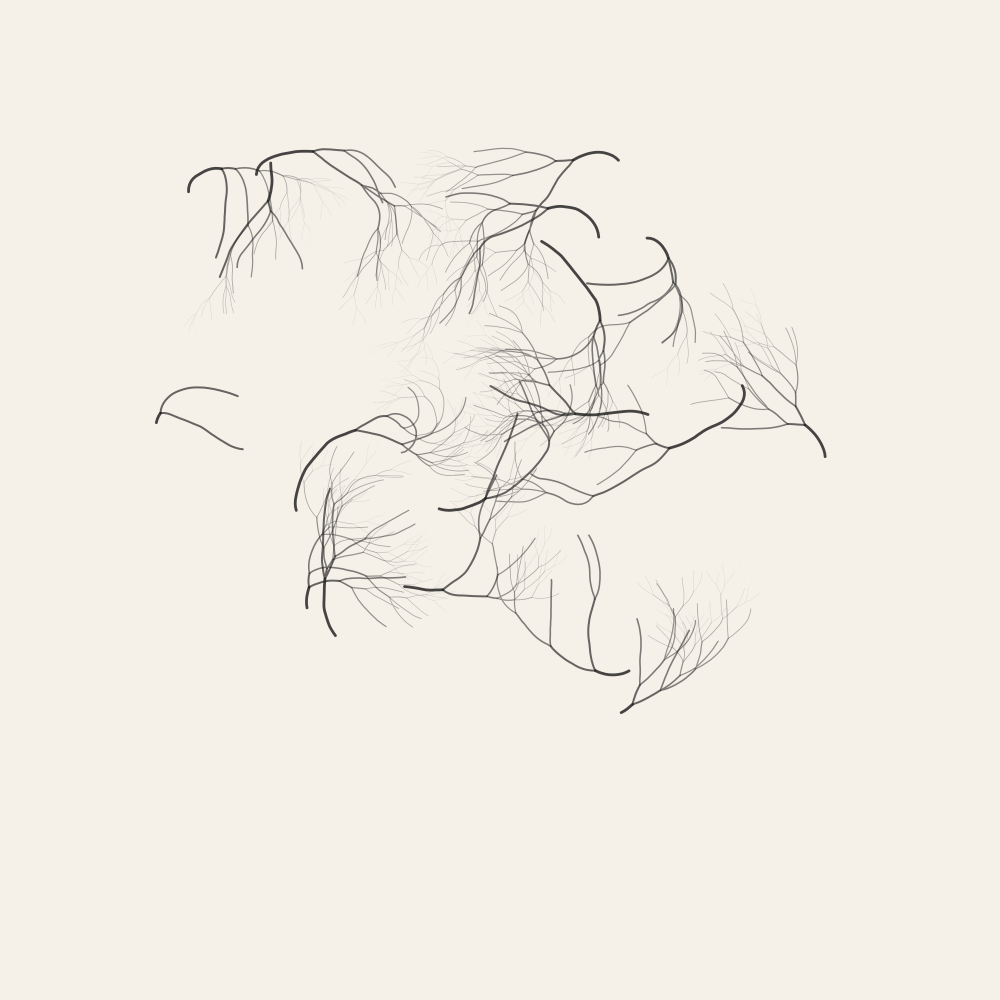
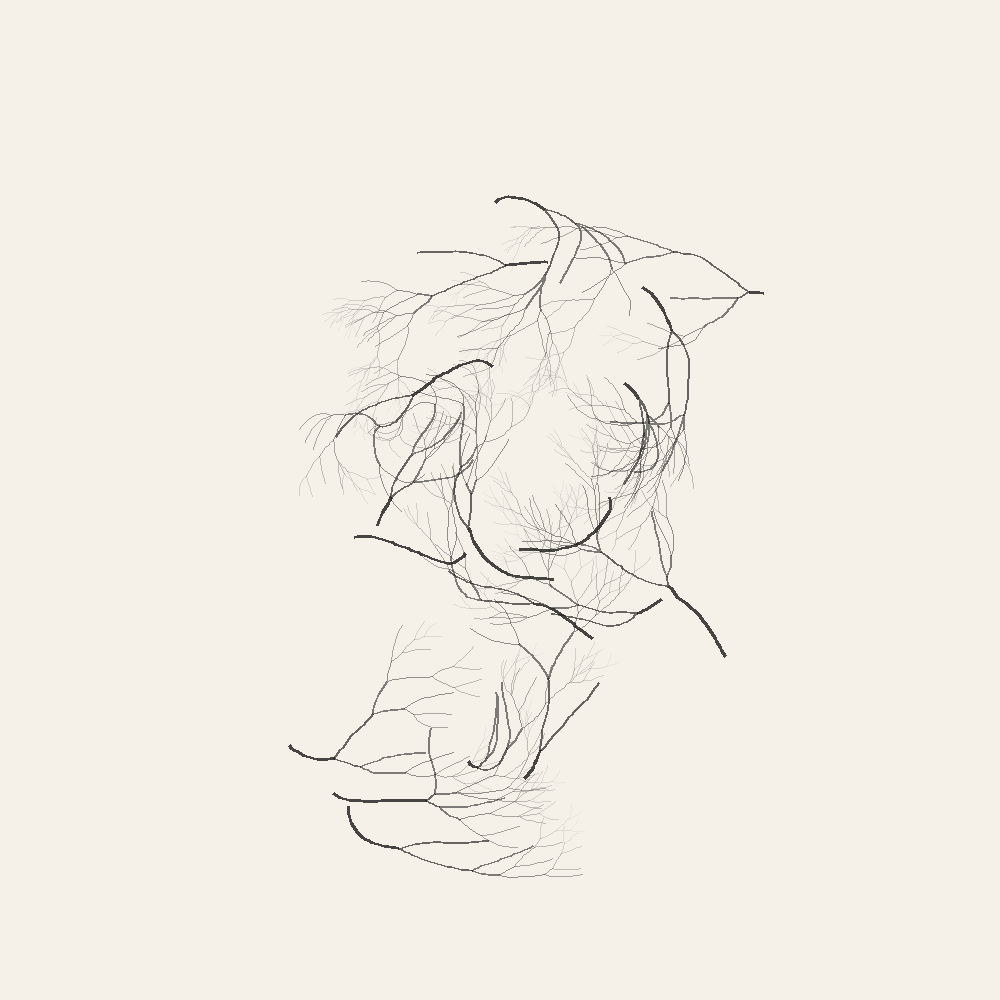
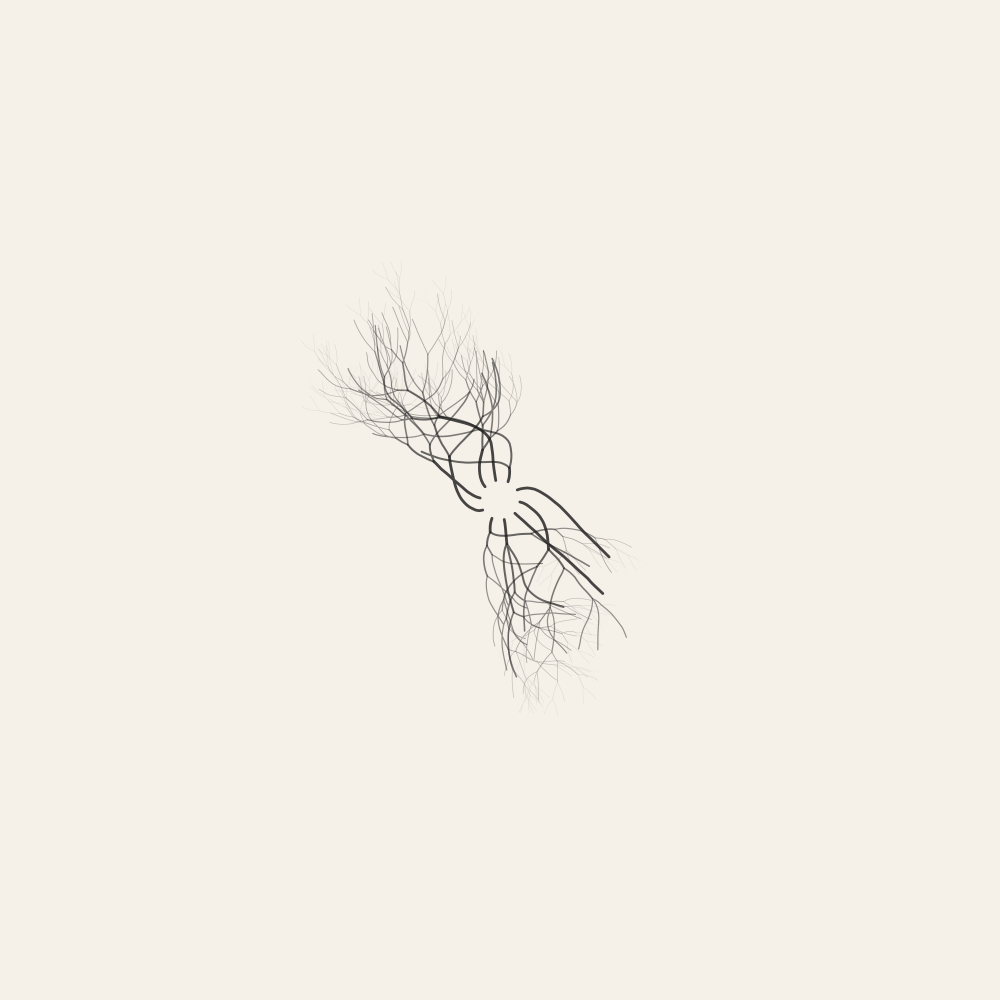
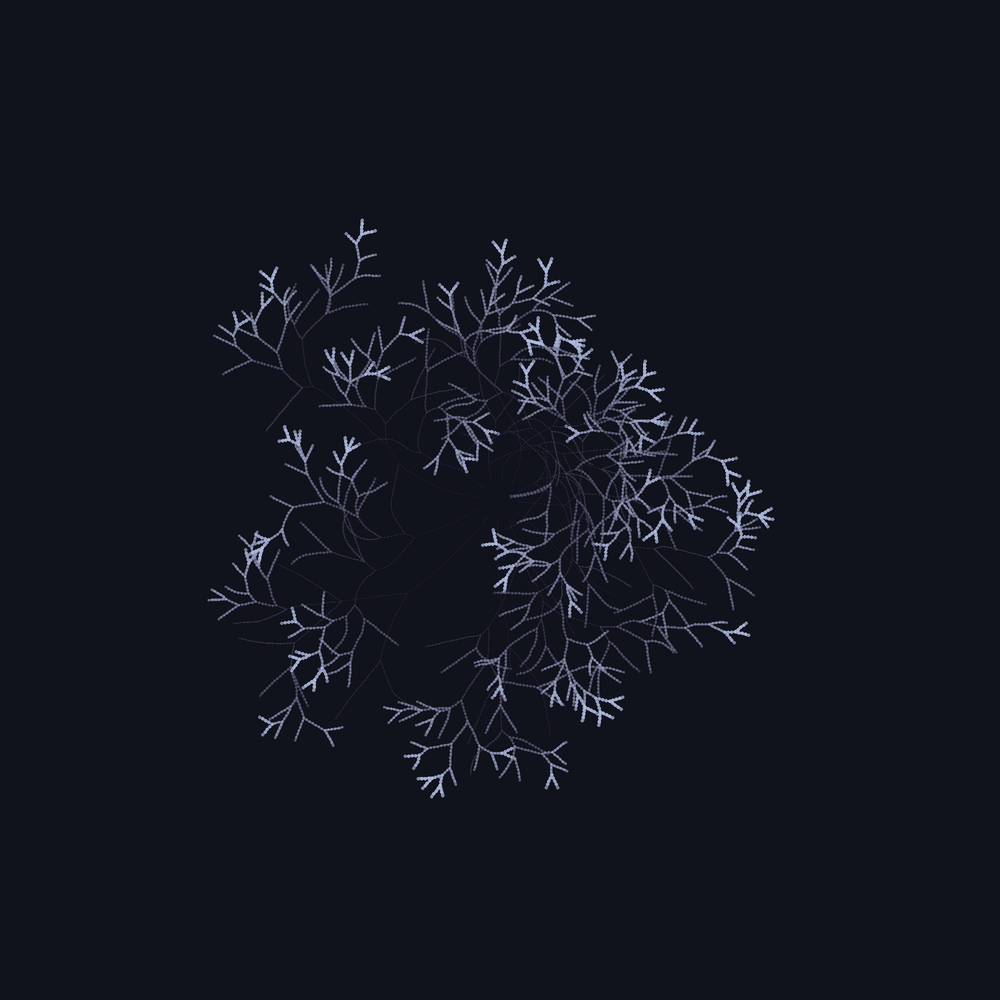
Recursive tip-growth-and-bifurcation inspired by natural phenomena — frost, roots, neurons. Three new techniques enter the toolkit: recursion (fractal branching), layering (exponential opacity tapering by depth), and feedback (density-aware growth that steers branches away from crowded areas).

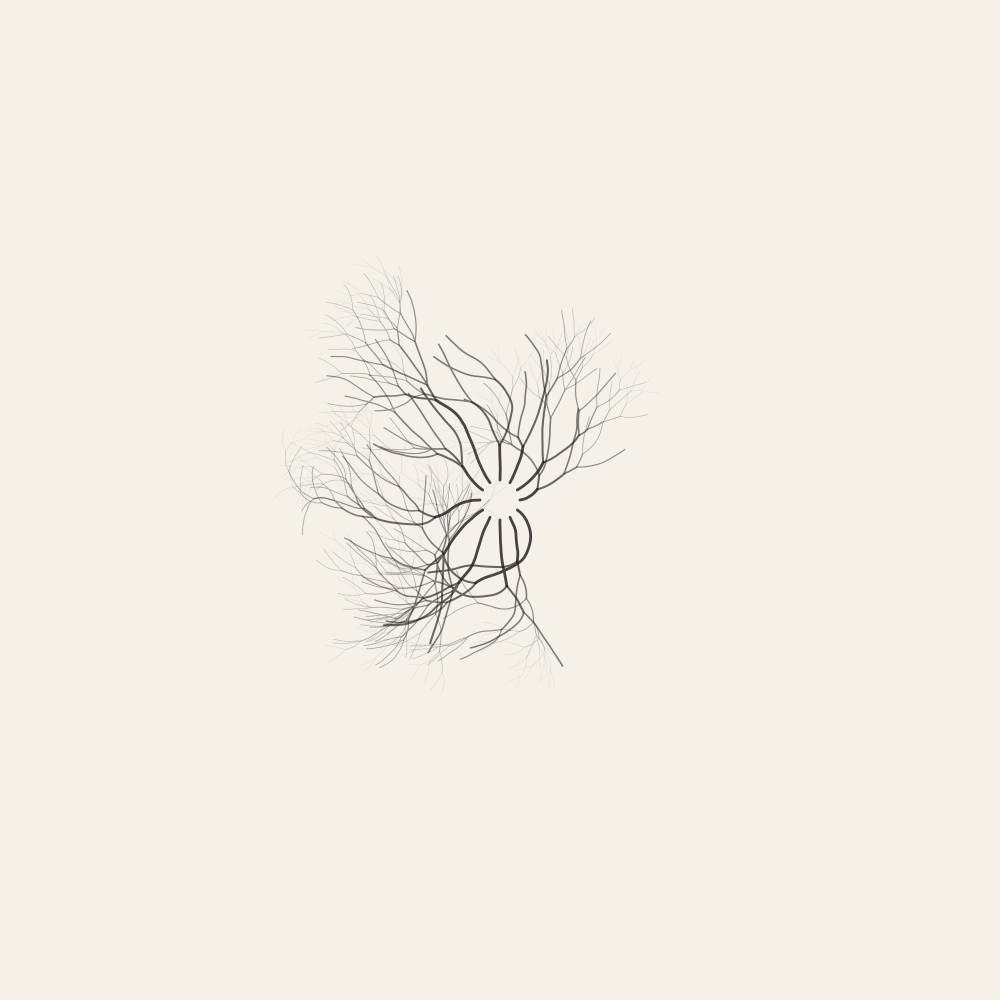
Twelve primary dendrites grow isotropically from a central soma, branching recursively to depth ten. Radial symmetry with organic variation. The opacity gradient creates a spherical depth effect — the center feels three-dimensional. Fine terminal branching forms a ghostly halo around the dense core.
The hybrid breakthrough: recursive dendritic growth guided by dynamic vector fields. Each branch segment samples the field at its position and blends its heading toward the field direction. The field provides macro-structure; recursion provides micro-structure. Multi-foci convergence fields produce network-like structures with identifiable attractors.

Two attractors pull scattered dendrites toward each other, creating a zone of interlace at the center. The convergence field makes the attraction force visible in the dendrite curvature itself — branches naturally arc toward the opposing focal point. The Synapse problem, solved by field topology.

Three focal points in triangular arrangement create a network topology. Competing attractors produce neutral zones and unexpected intersections impossible in dual-convergence. The triangle gives structural stability while maintaining dynamic tension. The convergence principle scales — with limits.

Neural structure sculpted by invisible magnetic force. The dipole field gently bends dendrites, creating asymmetry while maintaining biological radial form. The field influence is subtle enough that the piece reads as organic rather than mathematical — a tree growing in a magnetic field.

Chaotic branching creates a specimen-like quality. The Lorenz field produces unpredictable directional shifts, making the tree feel weathered and organic. Strong focal anchor at the origin point. Biological specimen with inherent chaos-theory intrigue.
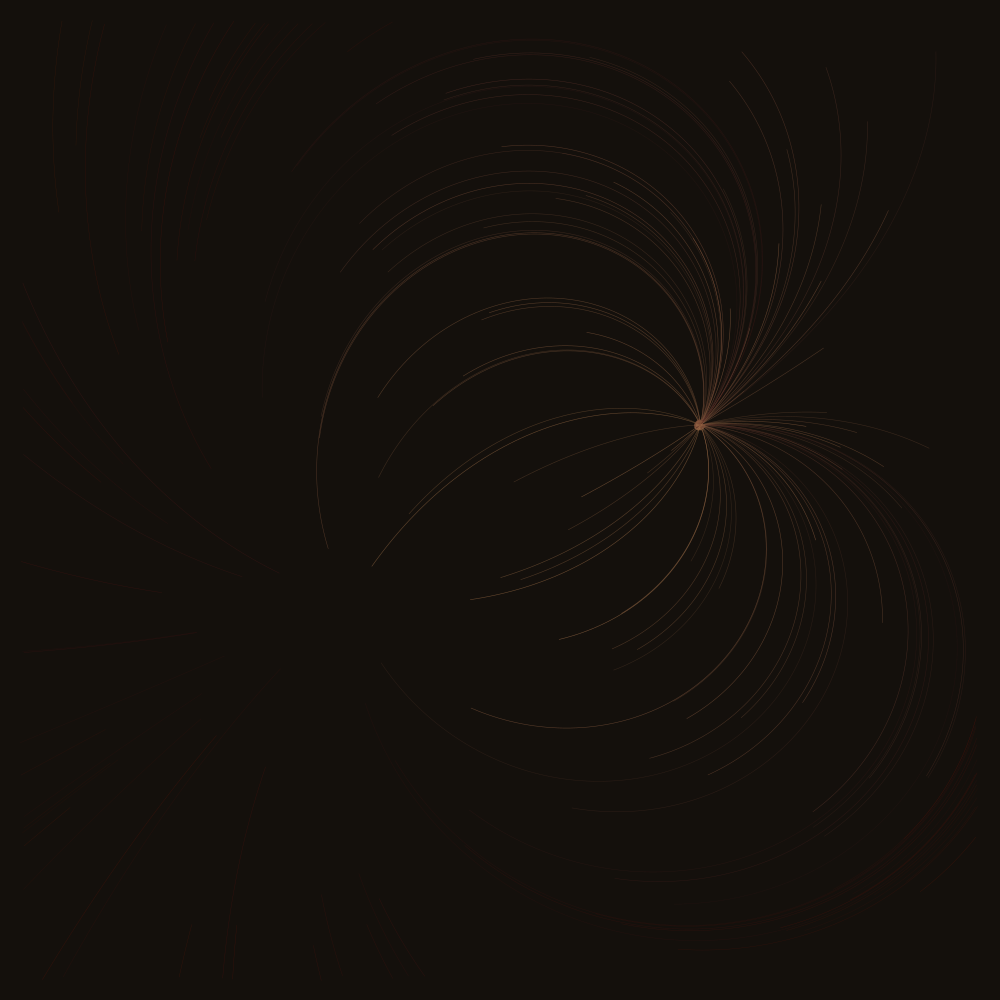
Color enters the work — not as decoration, but as structural reinforcement. Three channels of convergence: density (particle trail convergence), color (warm/bright at focal, dark/muted at edges), and stroke weight (thick at focal, thin at edges). Dark backgrounds let warm palettes glow. The same convergence principle, now visible to a different sense.

Distance from the focal point maps to the Copper Horizon cosine palette. Brightness falls 50% at edges; stroke weight tapers from 0.65px to 0.25px. Three channels aligned: density, warmth, and physical weight all converge. The focal point glows. Cinematic register — a different voice from the classical monochrome.

Field magnitude maps to the Patina palette with gamma correction. Attractor cores blaze green; peripheral zones fade to sage. The field's invisible force made directly visible — not through particle density, but through color itself. Asymmetric composition creates organic tension.
Selected visual studies have audio counterparts — Dittytoy compositions that translate the same field formula into sound. The convergence reinforcement principle transfers across modalities: density → harmonic density, focal proximity → pitch proximity, stroke weight → sustain. The same invisible architecture, heard.
The five paired studies — First Wind, Interference, Gradient Descent, Neuron, and Reveal — carry embedded players in their entries above: the same field formula, heard. Each player holds a three-minute performance of the composition, rendered from the exact script.
Audio-pair scripts (all thirteen studies) live in the repository under /scripts/audio-pairs; visual generator scripts under /scripts. Lab journal included — every translation decision is documented.